
Stream/Download
Amazon
Apple
iHeart
Pandora
Spotify
Tidal (High Definition)
YouTube Music
Composed by Walter Sommer and Tom Libertiny
Performed by Walter Sommer and his Orchestra
Produced, mixed, and mastered by Tom Libertiny
Victorian Series

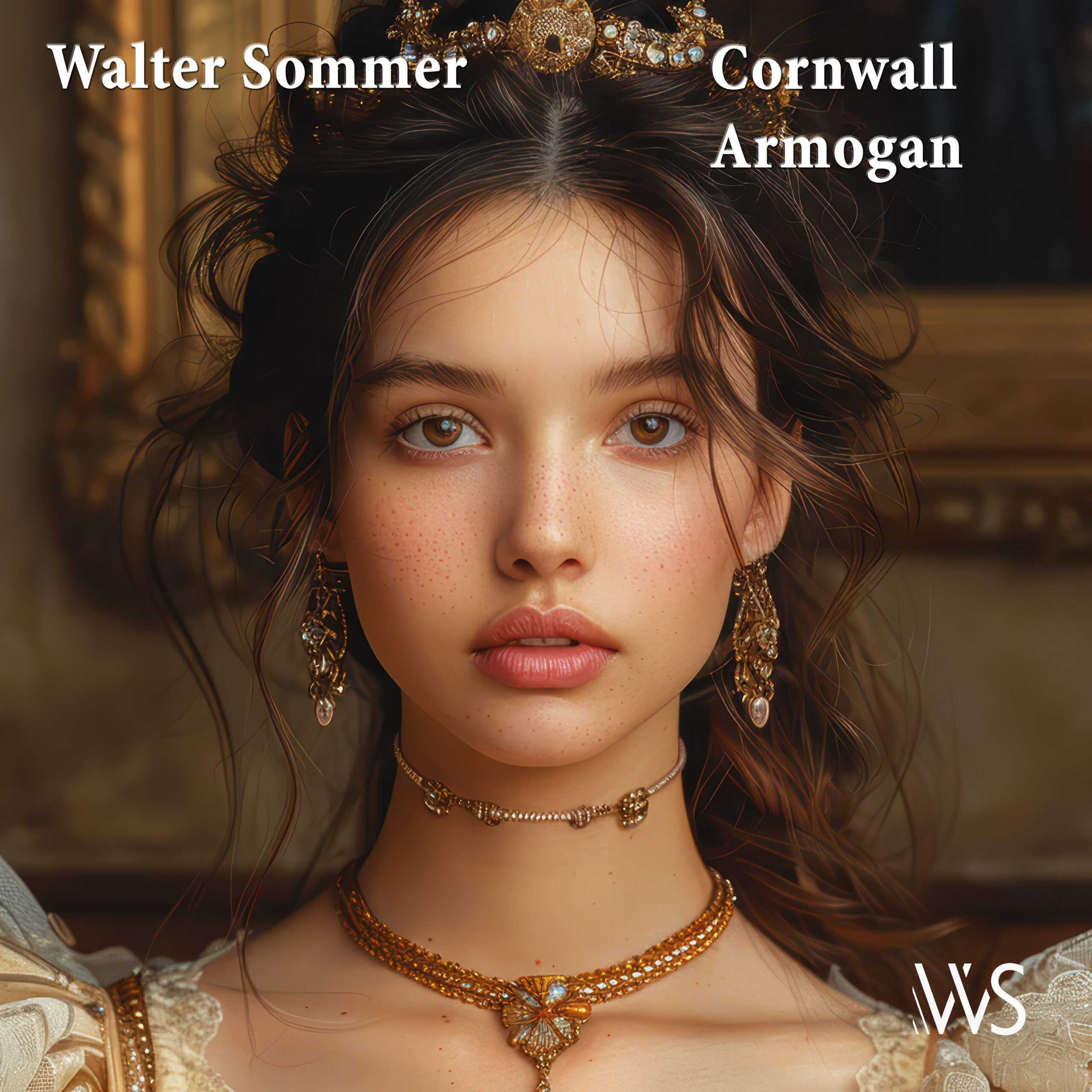
Cinematic Symphony, Victorian Series, Cornwall Armogan
As a child, I had a recurring dream of growing up in Cornwall, England, which seemed like a tapestry of contrasts. In the dream, I’m a German boy with brown hair and bright blue eyes, standing out among the rugged Cornish children. They seemed at home with the sea’s brine and the moor’s mysteries while I brought tales of the Black Forest.
I imagined that my grandfather was a clockmaker and had moved us to England, chasing a dream of mechanized wonders, finding fertile ground in the industrious spirit of Victorian Cornwall.
Fascinated by Cornwall’s ancient past, I listened intently to old fishermen and miners, their stories mingling with my grandmother’s legends about Germanic heroes and woodland spirits.
My vivid imagination turned the rugged landscape into a realm of knights and dragons. My imaginary friends and I would explore cliffs and coves, with me concocting epic quests and daring rescues.
One stormy evening, the sea claimed a ship, casting wreckage upon the shore. Leading the village boys, I discovered a chest among the debris. Inside were nautical instruments and strange devices. With my grandfather’s guidance, I repaired and understood them, becoming a local hero.
My ingenuity, nourished by Cornish legends and German precision, marked me as a bridge between worlds. My Victorian upbringing in Cornwall, intertwined with my German heritage, created a life rich in adventure and discovery. In time, I grew to be a renowned inventor, and my creations were a testament to the unique blend of cultures that shaped this extraordinary dream.
I always woke up with a lingering sense of wonder, as if the dream holds a piece of truth about my past, a life I might have lived, or a story my mind weaves from fragments of history and imagination.
Cornwall Armogan reminds me of my childhood dreams and the dreams that we can still chase as adults.

Nestled in the heart of Somerset, the Quantock Hills unfold like a breathtaking tapestry adorned with heather, ancient woodlands, and rugged heath. On a misty morning, a young woman named Eliza wandered through this natural masterpiece, her footsteps barely disturbing the dew-kissed grass. She was on a quest, seeking a piece of her past or a connection to the land that had nurtured generations before her.
As a single shaft of the sun pierced through the clouds, Eliza stumbled upon a secret glen. At its heart stood a solitary oak tree, its branches laden with the weight of time and wisdom. Underneath it, she discovered a small, weathered stone bearing the initials of a long-forgotten lover. In that moment, Eliza realized that the Quantock Hills were not just a repository of earth’s stories, but also the keeper of the hearts that had traversed its paths.
That’s the story I imagined for “Quantock Hills Messenger.” As with all of the music from this series, Quantock Hills is an ancient romantic place in England, and “Messenger” is an old term for the weather.

I first became aware of Royal Tunbridge in High Weald, England, when my father told me that it was the twin city of Wiesbaden, near where we lived in Germany. Both are spa cities, with Royal Tunbridge also enjoying beautiful vistas along the southwest coast of England.
My mother also was well acquainted with the city after watching the James Bond film On Her Majesty’s Secret Service. Bond remains one of her favorite movie characters, and she loved the idea of Mr. and Mrs. Bond living an idyllic life on Acacia Avenue in Royal Tunbridge
After visiting the area, I could imagine wealthy Victorian people strolling along The Pantiles into the Calverly Grounds. And what better way to enjoy a beautiful sunset in the Grounds than by dancing to a waltz?

Amidst the fierce snowstorm that engulfed the countryside, Eleanor sat nestled in a plush armchair before the roaring fireplace of her Victorian parlor. The flames leaped and crackled, casting a warm glow that danced upon the ornate wallpaper and illuminated the rich mahogany bookshelves lining the walls. Wrapped snuggly in a thick, embroidered shawl, she sipped delicately from a porcelain teacup, the fragrant aroma of chamomile and honey soothing her senses.
Outside, the world was a swirling tapestry of white. The wind howled like a restless spirit, sending snowflakes whipping against the frosted windowpanes. Trees bent under the weight of ice, their branches creaking in protest. Yet within these walls, a serene cocoon of comfort prevailed, isolating Eleanor from the storm’s relentless fury.
As the evening wore on, Eleanor felt a profound sense of gratitude. The storm outside might rage until dawn, but she was safe and content. The fireplace continued its tireless vigil against the cold, and she nestled deeper into her chair, allowing the gentle embrace of sleep to overtake her.
In the quiet hush of the Victorian parlor, amid the flickering shadows and the distant wail of the wind, Eleanor found her sanctuary—a haven of warmth and serenity that no storm could penetrate.

As the co-composer of “Cotswold Rain,” I wanted to capture the serene and romantic ambiance of a rainy day in the enchanting English countryside of the Cotswolds spent with a charming woman. This classical piano sonata is a musical reflection of the rolling hills, beautiful villages, and verdant meadows, all touched by the gentle showers and quiet moments of introspection that such a day inspires.

The Black Hills, more properly known as Blackdown Hills in England, is a historic area where the Normans settled. Beyond its beauty, what I find interesting about the area is the Normans’ influence on its architecture and culture. The Church of St Peter is built in the Norman Gothic style and exemplifies both their architecture and culture.
The Normans, originally Norse Vikings who settled in the region of Normandy in northern France, famously defeated England’s King Harold II at the Battle of Hastings under the leadership of William the Conqueror. By then, Normans encompassed not only Viking and French society but also those of Africa and the Middle East, and England became a richer country because of the cosmopolitan Norman culture. The Norman dynasty in England eventually merged with the Anglo-Saxon nobility, shaping the future of the British monarchy and leaving a lasting imprint on European history.
Bengy is an old southeast English dialect word meaning “overcast” or “threatening rain.” The Black Hills’ location, north of the English Channel, means the weather can change dramatically, and Bengy is a great description of what is often known as the weather that precedes an English Rain.
Together, the area and the weather description paint a picture of a cozy experience. It’s as if you can almost feel the warmth of a crackling fire in a Victorian parlor, sharing the time with a loved one, as the Bengy weather sets the perfect mood.

I’ve always had a complete fascination with London and its environs. London somehow manages to combine the hectic pace of a busy workday with little niches of calm carved out throughout the city. The lovely cafes on Lowndes Street near Hyde Park are such places. After a hectic morning one summer, I retreated to a cafe to compose “Kent Downs Twirlwind,” it ebbs and flows with the magical energy and quiet of London.

Harriet Martineau was a Victorian era hero. Lincolnshire Worlds Moonbrach is how I imagine she would have stood against the great storm of humanity with her brilliant wit.
Martineau (1802–1876) was a pioneering British writer, social theorist, and political economist, often regarded as the first female sociologist. Born in Norwich, England, into a large Unitarian family, Martineau overcame significant personal challenges, including deafness and ill health, to become a highly influential thinker and author.
Martineau wrote extensively on a wide range of topics, including economics, politics, and social issues. Her early works, such as “Illustrations of Political Economy” (1832-1834), were instrumental in making complex economic concepts understandable to the general public, earning her widespread recognition. Her progressive views on women’s rights, education, and the abolition of slavery also made her a significant figure in both the feminist and abolitionist movements.
Her travels to the United States in the 1830s resulted in the book “Society in America” (1837), which critically examined American society, particularly its treatment of women and enslaved people. Martineau was a staunch advocate for the abolition of slavery, and her writings contributed to the discourse on social reform during the 19th century.
Aside from her work in sociology and economics, Martineau was a versatile writer. She penned numerous novels, travel books, and historical works, and also made a mark as a respected journalist, contributing to major publications. Despite her personal health struggles, including a long battle with chronic illness, Martineau remained a prolific writer and thinker until she passed away in 1876.
Harriet Martineau’s legacy lies in her contributions to the development of social science and her advocacy for social justice, making her a trailblazer for women in the field of sociology and beyond.

In 1876, Henrietta Johnson stepped onto the bustling docks of London, the fog from the Thames enveloping the city in a misty embrace. As an African-American woman arriving from the United States with her husband, Thomas Lewis Johnson, she was both overwhelmed and exhilarated by the sights and sounds of Victorian England. They had come so Thomas could receive missionary training from the Baptist Missionary Society.
Henrietta immersed herself in London’s vibrant life, attending church meetings and forming friendships within the community. Yet amidst the city’s hustle, she longed for a respite. Upon a friend’s recommendation, she and Thomas decided to take a brief vacation to the countryside of Dorset. Traveling by train through picturesque landscapes of rolling hills and quaint villages, they arrived in the coastal town of Lyme Regis, where a sense of peace washed over her.
The seaside air was fresh and invigorating. They spent days strolling along the Jurassic Coast, collecting unique fossils washed ashore, and marveling at the cliffs and the endless expanse of the sea. Visiting local markets, they tasted homemade cheeses and fresh bread, engaging in warm conversations with townsfolk who welcomed them openly. A small music recital in a local chapel moved Henrietta deeply, the melodies echoing the gentle waves of the ocean. The vacation rekindled their spirits and strengthened their resolve for the mission work ahead.
Returning to London, Henrietta carried with her the tranquility found in Dorset. She shared tales of their experiences with friends, her eyes lighting up as she recounted the kindness of the people and the beauty of the countryside. The trip provided a much-needed break and deepened her appreciation for England’s diversity.
As they prepared for their journey to Cameroon, memories of Dorset remained vivid. When the time came to leave England, Henrietta felt a mix of gratitude and anticipation. Holding a small fossil—a token of their cherished vacation—she stood on deck beside Thomas as the ship set sail for Africa. Together, they looked toward the horizon, ready to bring hope and faith to new shores, carrying with them the serenity of Dorset and the lessons learned during their time in Victorian England.

Ada Lovelace was the only legitimate child of the poet Lord Byron and his wife Anne Isabella Milbanke (“Annabella”), Lady Wentworth.
Her mother was keen on ensuring Ada did not inherit her father’s perceived insanity, so she promoted Ada’s interest in mathematics and logic. Ada was tutored by several notable educators, including Mary Somerville, a Scottish astronomer and mathematician, who introduced her to Charles Babbage.
She also had the foresight to see the potential of computers to go beyond mere number-crunching, envisioning that they could create music and art if given the right programming.
Her contributions to the field of computer science were not widely recognized until the 20th century. Now, she is celebrated for her visionary understanding of computing. The computer language “Ada,” created by the U.S. Department of Defense, is named after her. Every year, Ada Lovelace Day is celebrated to highlight the achievements of women in science, technology, engineering, and maths (STEM).
This is my tribute to her.

It’s said that Queen Victoria brought the sunshine with her wherever she went. “Chiltern Hills Queen’s Weather” is my tribute to her and the Victorian era.
Amid the rolling emerald slopes of the Chiltern Hills, Queen Victoria sought solace from the burdens of the crown. The royal carriage wove through lanes shaded by ancient oaks, the air alive with birdsong and the scent of wildflowers. Stepping into a sunlit meadow, Her Majesty, clad in silken attire that mirrored the sky, embraced the tranquil beauty surrounding her.
Sunlight bathed her features in a gentle glow, and the Queen allowed herself a rare moment of peaceful reflection. She touched the delicate petals of a wild rose, mindful of the thorns symbolizing life’s blend of joy and adversity. As the sun began its graceful descent, casting golden hues across the landscape, Victoria felt a deep connection to the land she cherished.
Returning to the carriage with a renewed spirit, the Queen left the Chiltern Hills with a heart touched by nature’s serene splendor–a cherished memory etched in time.

The wind was still warm with the passing storm as Clara — or so she called herself today — walked along the Northumberland coast. The sky had begun to clear, and a rainbow arched across the horizon, cutting through the last gray clouds. She smiled. The rainbow was like a secret, just for her, and perhaps that’s what this life had become: a series of beautiful, hidden things.
In the world she left behind, she had a different name. Anne Elizabeth Baker. The sister of George Barker, a writer of topography and history. For over sixty years, Anne was his constant companion.
But in this alternate history, Anne was destined for marriage to a gentleman of good breeding and better fortune. She could see her mother’s face now, stern and drawn as if her entire life had been spent tightening a corset that could never quite be cinched enough.
“Anne,” her mother would say in that clipped tone that held no room for deviation, “you mustn’t look like that. You mustn’t think like that.”
As if her very thoughts were a betrayal.
Clara—no, Anne—laughed quietly to herself. She had once believed them, those words. Believed that her life would only have value if lived through the expectations of others. But that belief had shattered the moment she sold her first story under the name of H.F. Everly. A small piece, barely more than a sketch, but one that sent ripples through London’s literary circles. And yet, no one knew it was her.
That was her power. The woman no one could see, the voice no one could trace. She lived between two worlds now—the obedient daughter who sat with needle and thread in the parlor and the radical writer penning words to free other women like her from the chains of their own lives.
On the beach, her skirts, heavy from the damp air, dragged against the sand, but she barely noticed. Something was intoxicating about this walk, alone, with no one watching, no one expecting her to be anything but what she was in that moment. She could feel the ocean’s pulse through the soles of her boots, the rhythm of her own steps matching its heartbeat. For the first time in years, she was fully herself.
No father dictating her movements. No mother arranging her future. Just Clara. Or Anne. Or H.F. Everly. Or perhaps all of them.
The rainbow stretched further now, a vivid arc, promising the world but asking nothing in return. She paused, her hands brushing the edge of her skirts as she watched it, knowing the storm was behind her, both on the horizon and in her life. Her family would not understand the choices she had made. They would think her mad, perhaps even ruined.
But the truth was simple: she had never felt more whole.
Turning, she looked back at the storm clouds as they receded into the distance. They would always be there, she knew. The expectations, the weight of tradition and the role she was born into—those things were part of her past, as inevitable as the rain.
But rain was not the end.
Anne smiled at the rainbow once more. It was, after all, only the beginning.
This is my tribute to self-made people.