
Stream/Download
Amazon
Apple
iHeart
Pandora
Spotify
Tidal (High Definition)
YouTube Music
Composed by Walter Sommer and Tom Libertiny
Performed by Walter Sommer and his Orchestra
Produced, mixed, and mastered by Tom Libertiny
Superhero Series

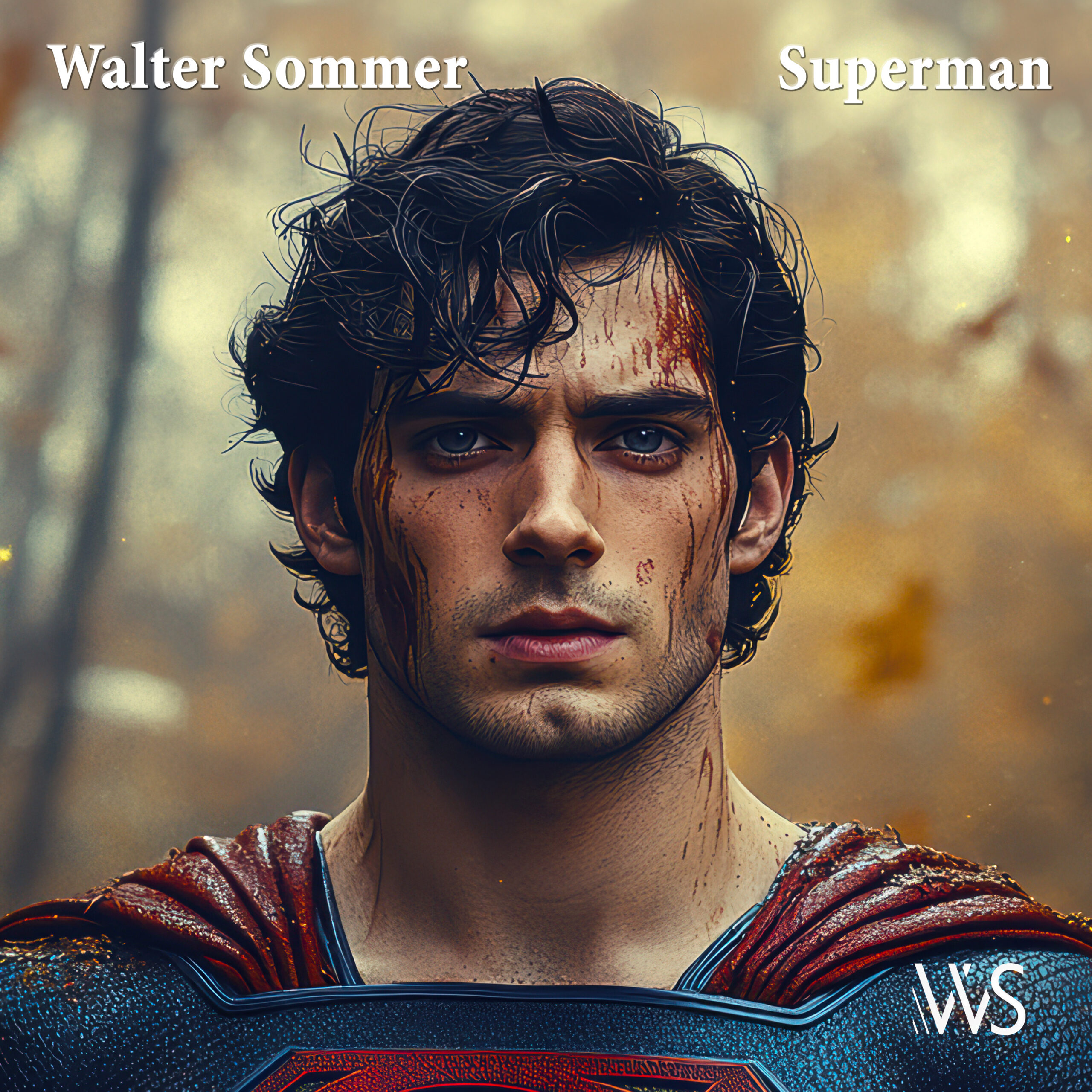
Superman is one of the most iconic superheroes in comic book history, created by writer Jerry Siegel and artist Joe Shuster. He first appeared in Action Comics #1 in June 1938, published by DC Comics.
Superman’s origins trace back to the planet Krypton, where he was born as Kal-El. Before Krypton’s destruction, his parents Jor-El and Lara sent him to Earth in a small spaceship to save him from the impending catastrophe.
Upon arriving on Earth, he was found and adopted by a Kansas farming couple, Jonathan and Martha Kent, who named him Clark Kent. Raised with strong moral values, Clark discovered he possessed extraordinary abilities due to Earth’s yellow sun, including super strength, flight, invulnerability, heat vision, and x-ray vision.
As an adult, Clark moved to the city of Metropolis, where he worked as a journalist for the Daily Planet. He adopted the alter ego “Superman” to use his powers to protect humanity and fight against villains such as Lex Luthor, Brainiac, and General Zod. His strong sense of justice and commitment to doing good made him a symbol of hope.
Superman’s legacy extends beyond entertainment; he has become a cultural icon representing truth, justice, and the fight against evil. His stories often explore themes of identity, morality, and the immigrant experience, resonating with audiences worldwide.

Batgirl (originally Bat-Girl) is the name of several fictional superheroines appearing in American comic books published by DC Comics, depicted as female counterparts and allies to the superhero Batman. The character Betty Kane was introduced into publication in 1961 by Bill Finger and Sheldon Moldoff as Bat-Girl. Betty Kane is the niece of Kathy Kane (Batwoman) with her secret identity being replaced in 1967 by Barbara Gordon, who became the most iconic Batgirl. The character debuted in Detective Comics #359 (January 1967) by writer Gardner Fox and artist Carmine Infantino, introduced as the niece/adoptive daughter of police commissioner James Gordon.
Barbara is a brilliant and determined young woman with exceptional skills in martial arts, detective work, and technology. After donning a costume for a masquerade party, she inadvertently stops a crime, inspiring her to become Batgirl and fight alongside Batman and Robin.
As Batgirl, Barbara becomes a key member of the Bat-Family, balancing her crime-fighting duties with her career as a librarian and her strong moral compass. Her character represents intelligence, independence, and resilience, appealing to younger readers and providing an inspiring role model.

In the shadow of a war-torn world, a young man named Steve Rogers dreamed of fighting for freedom. But Steve was no warrior—he was a frail, sickly kid, the kind of boy who got knocked down more than he stood tall. Yet, what he lacked in strength, he made up for in heart. Steve never backed down from a fight, no matter how outmatched, because he believed in standing up for what was right.
The world was at war, and Steve couldn’t sit idly by while others fought. He tried to enlist in the army, but his weak body and poor health saw him rejected time and again. Still, fate had other plans for Steve. His unyielding determination caught the eye of a secret government project searching for a volunteer—not just anyone, but someone brave enough to risk everything for their country.
Steve was chosen to undergo an experiment called the Super Soldier Program. In a quiet lab, surrounded by scientists and generals, he was injected with the Super Soldier Serum. Pain wracked his body, but Steve never cried out. When the process was over, the frail young man had transformed into something extraordinary—a man at the peak of human potential, strong, fast, and resilient. Steve Rogers had become Captain America.
Donning a costume of red, white, and blue, and armed with a shield made of unbreakable vibranium, Captain America became a symbol of hope in the darkest of times.
Captain America is a Marvel Comics superhero created by Joe Simon and Jack Kirby, debuting in Captain America Comics #1 (March 1941). He was conceived as a patriotic symbol during World War II, embodying courage, resilience, and the fight against tyranny.

Selina Kyle, better known as “Catwoman,” first appeared in Batman #1 in 1940, created by Bob Kane and Bill Finger. A master thief and antiheroine, Catwoman has become one of the most enduring characters in comic book history. Growing up in the shadows of Gotham City, Selina’s backstory varies across adaptations but often includes themes of poverty and survival in a harsh environment. After escaping an abusive home or fending for herself on the streets, she honed her skills in stealth, agility, and cunning, eventually adopting the persona of Catwoman. Her cat-like costume and abilities symbolize her independence and grace, traits that define her identity.
As Catwoman, Selina Kyle operates in morally ambiguous territory, often stealing from the corrupt while protecting the vulnerable. Her relationship with Batman is central to her story, marked by mutual attraction, respect, and conflict. While Batman embodies a strict moral code, Catwoman challenges his worldview, navigating the gray areas of morality with her personal ethics. This dynamic adds depth to her character, as she often walks the line between hero and villain. In some storylines, she transitions into a vigilante, protecting Gotham’s downtrodden communities, though she never fully abandons her independence or thieving ways.
Catwoman’s skills are legendary. She is an expert thief, skilled in lock-picking, infiltration, and evasion. Her agility and acrobatic abilities make her nearly impossible to catch, while her hand-to-hand combat skills and mastery of the bullwhip ensure she can handle any adversary. Intellectually, Selina is resourceful and cunning, often outsmarting both heroes and villains alike. These attributes have made her a formidable figure in Gotham’s underworld and an essential ally—or adversary—to Batman.

The original “Green Lantern,” Alan Scott, debuted in All-American Comics #16 in July 1940, created by writer Bill Finger and artist Martin Nodell. Alan Scott’s Green Lantern was distinct from the later iterations tied to the Green Lantern Corps and the intergalactic mythology. His story was rooted in mysticism and personal heroism.
Alan Scott’s powers came from a mystical green flame contained within a meteor that crashed on Earth thousands of years ago. This flame was later forged into a lamp and eventually a ring. The meteor’s energy, tied to the concept of willpower and combating evil, guided its bearers across generations. In 1940, Alan, a railroad engineer, survived a sabotage attempt on a bridge he was working on. The mystical flame appeared to him and instructed him to craft a ring and lantern to harness its power. Using the ring, he could create solid-light constructs, fly, and wield immense strength. However, his ring was ineffective against wood, a vulnerability rooted in the magical origins of his power.
Alan adopted the persona of the Green Lantern to fight crime and corruption, often in standalone adventures set in a grounded, urban environment. He remains a symbol of courage and individuality, embodying the timeless heroism of the Golden Age of comics.

Phantom Lady is one of the earliest and most notable female superheroes from the Golden Age of Comics. Created in 1941 by Arthur F. Peddy, her character was later redefined by artist Matt Baker, whose vibrant and dynamic illustrations elevated her popularity. As the alter ego of Sandra Knight, Phantom Lady emerged as a daring, independent socialite who used her intelligence, bravery, and cutting-edge technology to fight crime and injustice.
Sandra Knight’s transformation into Phantom Lady marked her commitment to making a difference beyond the privileges of her wealthy background. She carried a unique weapon: a “black light projector,” capable of casting total darkness to confuse and disarm her enemies. Unlike many superheroes of her era, Phantom Lady had no superpowers, relying instead on her wits, hand-to-hand combat skills, and scientific ingenuity to take down villains. Her stories often combined crime-fighting adventures with a sense of glamour and intrigue, offering readers both escapism and empowerment.
Phantom Lady’s costume became an iconic part of her identity. The daring design sparked controversy, reflecting the era’s shifting cultural attitudes toward women in media. She was bold, confident, and unapologetic, which resonated with readers and distinguished her in a male-dominated genre.
Her legacy endures as a symbol of innovation in comic storytelling and character design. She paved the way for future heroines by proving that women in comics could be as courageous and capable as their male counterparts, breaking stereotypes and creating a lasting impact in the world of superhero narratives.

Spider-Man was created by writer Stan Lee and artist Steve Ditko, making his debut in Amazing Fantasy #15 in 1962. Marvel Comics was looking to appeal to a younger audience, and Spider-Man stood out as one of the first superheroes who wasn’t a traditional adult hero but rather a relatable teenager grappling with real-life problems.
In Peter Parker’s origin story, he’s introduced as a shy, academically gifted high school student. After a bite from a radioactive spider, he discovers he has gained spider-like abilities. Initially, he tries to exploit these powers for fame and money but learns a painful lesson when he chooses not to stop a thief who later kills his beloved Uncle Ben. This moment solidifies his dedication to fighting crime, driven by Uncle Ben’s iconic message, “With great power comes great responsibility.”
His relatability, resilience, and unwavering sense of duty continue to inspire generations, making Spider-Man a timeless symbol of heroism.

Long before the name “Black Widow” became synonymous with Marvel’s Natasha Romanoff, another woman bore the mantle as the comic book world’s first costumed, superpowered female superhero: Claire Voyant (a play on the word: clairvoyant). Debuting in August 1940 within the pages of Mystic Comics #4, published by Timely Comics (the precursor to Marvel Comics), Claire Voyant’s Black Widow broke new ground in a male-dominated genre.
Created by writer George Kapitan and artist Harry Sahle, Claire Voyant emerged during the Golden Age of comics—a period marked by the introduction of iconic characters like Superman, Batman, and Wonder Woman. Unlike her contemporaries, Claire’s narrative delved into the supernatural and the macabre, setting her apart from other heroes of her time.
Claire Voyant was introduced as a spirit medium, a woman with a connection to the ethereal plane. Her life took a dark turn when she became entangled with a criminal gang. Betrayed and murdered, Claire’s soul descended into the underworld. There, she encountered Satan—or, as referred to in the comics, the “Emissary of Hell.” Struck by her untapped potential for vengeance, he resurrected her, granting her supernatural powers with a singular mission: to serve as an agent of divine retribution on Earth.
- Death Touch: Claire possesses the lethal ability to kill with a single touch, a power she uses to dispatch evildoers and send their souls to the underworld.
- Telepathy and Mind Control: Her mental faculties are enhanced, allowing her to communicate telepathically and influence the minds of others.
- Mystical Knowledge: With her connection to the supernatural, she wields extensive knowledge of occult practices and rituals.
Claire Voyant’s Black Widow holds the distinction of being the first costumed female superhero with superpowers in comic book history. She predates other legendary heroines, including Wonder Woman, who debuted a year later in December 1941. Claire’s existence challenged the norms of her era, proving that female characters could hold their own in narratives filled with action, complexity, and moral ambiguity.
The stories of Black Widow ventured into unconventional themes for the time, especially for female characters. Tales of vengeance, mortality, and the supernatural were central to her narrative. She didn’t merely capture criminals; she delivered final judgments, reflecting a more severe form of justice that paralleled the grim realities of the world during that era.
While Claire Voyant may not have achieved the enduring fame of some of her peers, her influence is undeniable. She paved the way for future female characters who would also break free from traditional roles and embody a range of personas—from antiheroes to leaders and complex protagonists.

The Golden Age “The Flash,” introduced as Jay Garrick, debuted in Flash Comics #1 in 1940, created by Gardner Fox and Harry Lampert. Jay Garrick was the first superhero to bear the name “The Flash.” His origin story revolves around a freak accident in which he inhales “hard water” vapors in a college laboratory, granting him the ability to move at superhuman speeds.
Jay’s character was depicted as a cheerful, good-natured hero who used his powers to fight crime in Keystone City. His trademark look featured a winged helmet inspired by the Greek god Mercury, a red shirt with a lightning bolt emblem, and blue pants. Unlike later iterations of the Flash, Jay’s stories were whimsical and often reflected the optimistic spirit of the 1940s.
Jay was also a founding member of the Justice Society of America (JSA), the first-ever superhero team in comics, cementing his place in comic book history. His popularity waned after World War II, as superhero comics fell out of favor, but he remained an enduring symbol of the Golden Age of Comics.
Jay Garrick’s legacy was later honored during the Silver Age when DC reintroduced the concept of The Flash with a new character, Barry Allen, and established Jay as a hero from an alternate universe (Earth-2). This multiverse concept allowed Jay Garrick to remain a key figure in DC lore, symbolizing the origins of the superhero genre.

Wonder Woman is a pioneering superheroine who has become an iconic figure in comic books and popular culture. Created by psychologist and writer William Moulton Marston and artist H.G. Peter, she first appeared in All Star Comics #8 in October 1941. Marston, who was instrumental in developing the polygraph test, infused the character with themes of love, justice, and gender equality, aiming to provide a strong female role model in a male-dominated genre.
Born as Princess Diana of Themyscira, an island inhabited by the Amazon warriors of Greek mythology, Wonder Woman is gifted with superhuman strength, speed, and agility by the Greek gods. She wields the Lasso of Truth, which compels honesty, indestructible bracelets that can deflect bullets, and a tiara that can be used as a projectile weapon. Her character combines elements of a warrior and a diplomat, often emphasizing peace over conflict.
Wonder Woman remains a symbol of empowerment, equality, and justice. Her enduring presence in various media highlights her significance as a cultural and feminist icon. She continues to inspire new generations, reinforcing the idea that compassion and strength are not mutually exclusive.

Batman is a superhero created by artist Bob Kane and writer Bill Finger for DC Comics, first appearing in Detective Comics #27 in 1939. His secret identity is Bruce Wayne, a wealthy industrialist, philanthropist, and owner of Wayne Enterprises in Gotham City.
Traumatized by witnessing the murder of his parents as a child, Bruce swears vengeance against criminals, channeling his grief and anger into a lifelong crusade against crime.
Unlike many superheroes, Batman possesses no superhuman abilities. Instead, he relies on his exceptional intellect, peak physical conditioning, martial arts skills, detective expertise, and access to advanced technology and resources. He operates from the Batcave beneath his mansion and uses a variety of gadgets and vehicles, most notably the Batmobile.
Batman is celebrated for exploring complex themes such as justice, morality, identity, and the psychological effects of trauma.

Miss Fury is a pioneering superheroine who made her debut on April 6, 1941 as “The Black Fury” before being renamed “Miss Fury” a few months later. Created by June Tarpé Mills, she holds the distinction of being the first female superhero created by a female cartoonist. The character originally appeared in a newspaper comic strip and later transitioned into comic books, captivating audiences with her daring adventures and stylish persona.
June Tarpé Mills, working under the gender-ambiguous name “Tarpé Mills” to avoid prejudice in the male-dominated industry, both wrote and illustrated the series.
Mills’s artistry stood out for its sophisticated style and attention to detail, particularly in fashion and design. The strip was notable for its realistic depictions of women and complex storytelling that blended action, romance, and intrigue.
The protagonist, Marla Drake, is a wealthy socialite who becomes the costumed adventurer Miss Fury after donning a ceremonial panther skin suit. Unlike many superheroes of the time, Miss Fury did not possess supernatural powers but relied on her agility, intelligence, and combat skills.
Miss Fury remains a significant figure in comic book history, emblematic of early strides toward gender equality in the medium. Her adventures continue to resonate, offering a glimpse into the evolution of female superheroes and the artists who brought them to life.